

What should you do?
Build a country-by-country coverage checklist before you select a travel eSIM; regional labels alone are not proof that every stop is included.
Use the three-stage decision framework below, then confirm the exact purchasable TripoSIM plan at checkout. This website is owned by BroadNet and promotes TripoSIM; it is not an independent multi-provider marketplace.
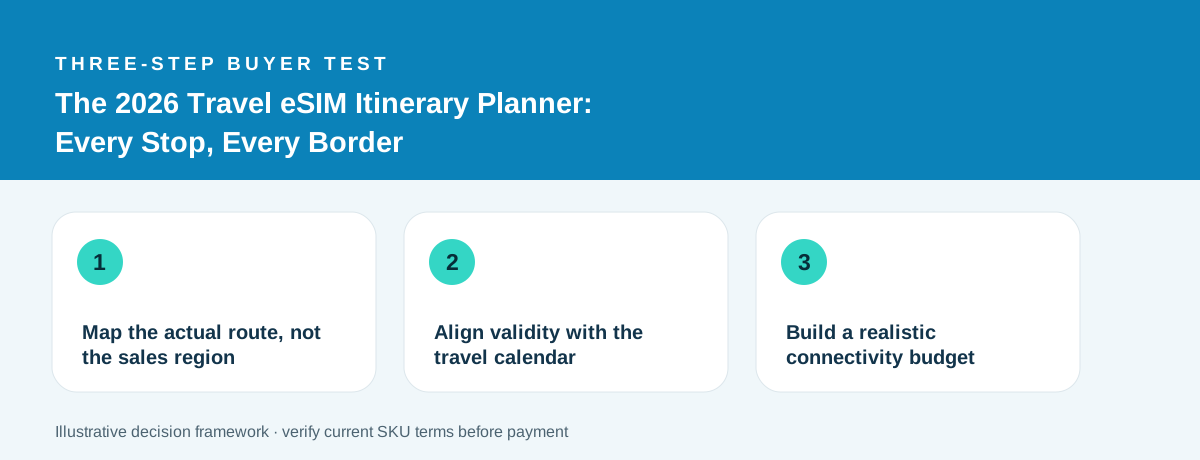
Map the actual route, not the sales region
Write down each country you will physically enter, including airport connections, day trips, road borders and cruise embarkation ports. Compare the country list against the specific product rather than an adjacent regional landing page. A plan marked “Europe” is not a promise about every non-EU country and microstate. The useful question is not whether a country appears in a broad country research table, but whether that exact SKU lists the destination under coverage.
For an itinerary of Amsterdam, London and Zürich, three border rules matter. A customer may have included home-plan data in the Netherlands, separate arrangements in the United Kingdom and a further tariff in Switzerland. An eSIM covering the Netherlands does not establish that London or Zürich are included. Ask the seller to confirm the exact plan geography.
Create two inventories: countries you will stay in and countries you may unexpectedly enter. The second group includes a day trip, a diverted flight or a rail segment across an unplanned frontier. Add a clear fallback for each critical stop, particularly the first arrival.
Align validity with the travel calendar
Look for the activation rule in the actual product terms. Some plans begin on installation, others on first supported-network attachment, and others follow a defined activation window. You cannot infer this from a national average or a headline number of days. Count the full interval from when you first need service through the final transfer, with a buffer for delays.
A seven-day package bought for an eight-night trip is not automatically enough, even if the traveler expects to use it only for five busy sightseeing days. A validity period is a clock, not a tally of days with traffic. Ensure the first and last travel dates are included, then confirm top-up availability and whether top-ups extend validity.
Separate the plan selection stage from actual installation. Save the QR instructions and account confirmation before the flight, but follow the seller’s activation guidance. In some cases an early installation will consume validity; a generic website cannot make that decision for you.
Build a realistic connectivity budget
Budget per traveler and per device rather than assuming one eSIM can be shared without restriction. Maps, ride-hailing, messages and bookings may be modest, but media uploads, video meetings and laptop tethering can change the estimate dramatically. If you plan to share through a hotspot, check that tethering is permitted under the exact plan.
For a hypothetical family of three using 0.35 GB each per day across ten days, the combined mathematical estimate is 10.5 GB, before extra navigation and sharing overhead. This is not a vendor quote or a prediction of usage; it is a transparent starting assumption you can replace with actual past device usage.
Keep a backup that does not require mobile data to work: offline maps, hotel address, local emergency numbers and a copy of arrival instructions. Connectivity decisions are about risk reduction, not only buying the cheapest allowance.
A decision you can use today
Choose a product only after you can answer the three questions above with evidence from its own listing. A useful outcome may be to keep your existing roaming plan, purchase a destination-specific eSIM, or choose a larger valid data allowance. The right answer depends on your actual itinerary and requirements.
Ready to compare current offers?
Use our existing buyer tools to work out your needs, then inspect the current TripoSIM plan details. Historical country observations are not final checkout prices.
Open the decision tools →View TripoSIM plans ↗Sources and editorial notes
Research method: source-specific technical guidance plus transparent arithmetic illustrations. None of the examples are independently measured customer usage, live supplier quotes or device tests. Reviewed 4 November 2026.