New · 2026 buyer research
Travel eSIM Route, Device & Arrival Playbook
Build your itinerary around real network coverage, device eligibility and arrival-day risks.
Read new field guide →
New · November 2026
Six new, illustrated and topic-specific guides plus an interactive, in-browser decision studio.
Route-first travel eSIM advice, arrival procedures, multi-country coverage and emergency communication.
Three independent research paths to make the next mobile-data decision safer and clearer. Each guide includes original diagrams, practical checks, primary-source references and a transparent TripoSIM affiliation.

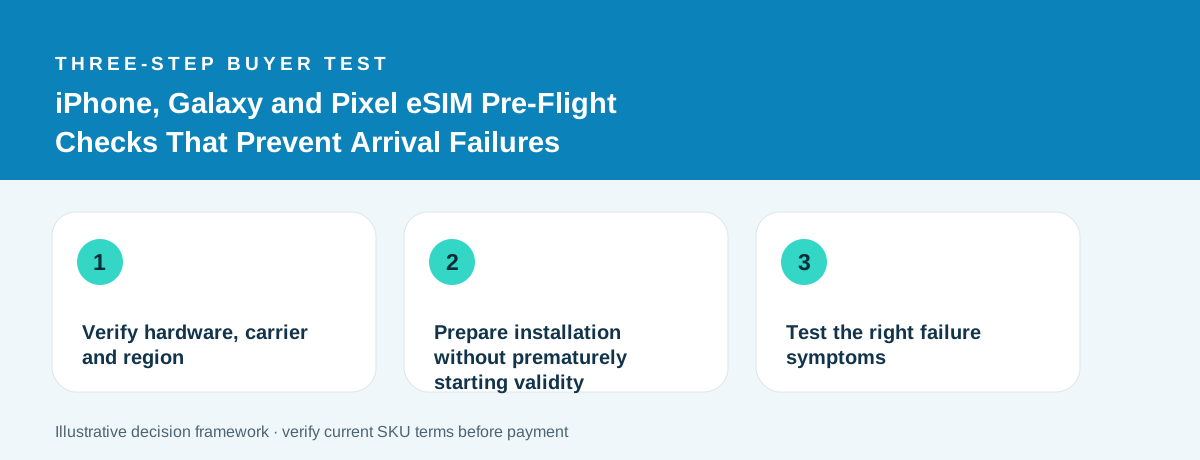

Build a reliable eSIM plan for a real itinerary: devices, borders, arrival activation, local networks and a backup strategy.
Explore the in-depth research →
No articles match. Try another term or change the topic.
Build your itinerary around real network coverage, device eligibility and arrival-day risks.
Read new field guide →Check iPhone carrier unlock status, eSIM support and data-line choices before buying an international plan.
Read original guide →A practical Galaxy installation and data-selection plan to avoid roaming surprises on arrival.
Read original guide →How Pixel owners can preserve their primary line while using a travel eSIM for data.
Read original guide →A two-person Japan itinerary comparison using device count, daily movement, battery and backup needs.
Read original guide →A route-first checklist for travelers crossing the UK–Ireland border and choosing regional data.
Read original guide →Mobile coverage, offline navigation and spare connectivity for journeys beyond Australian city centers.
Read original guide →How to verify coverage and validity for a short Dubai-to-Muscat itinerary.
Read original guide →What continues working when a travel plan supplies data but no ordinary phone number.
Read original guide →A device-replacement checklist for travelers who no longer have easy access to their eSIM activation details.
Read original guide →
Business travel teams need an arrival plan, not merely a shared list of data packages. Learn how to verify country coverage, plan eligibility, data needs a
Read guide →
A transit airport is not automatically a covered destination, and a landing is not always a usable roaming session.
Read guide →
Mobile data is one part of an emergency communications plan; voice, SMS and offline preparation are separate dependencies.
Read guide →
For two weeks in the UK, choose a UK-specific eSIM unless other European countries are genuinely part of the trip.
Read guide →
Use an offline-first arrival routine, dual-SIM checks, and a controlled troubleshooting sequence rather than buying another plan immediately.
Read guide →
If you cannot count on airport Wi-Fi, install the eSIM profile at home and switch it on only after landing. Before leaving, store the QR code or manual…
Read guide →
A practical offline-first arrival sequence for travelers who need navigation or a ride before finding reliable airport Wi-Fi.
Read guide →
Plan a sales team's conference data person by person: list each attendee's destination, dates, phone model, unlock status and expected use, then name a plan…
Read guide →
A country travel eSIM covers land-based mobile networks in port, not the ship's maritime cellular or satellite service at sea.
Read guide →
For a Dubai and Abu Dhabi business trip, choose a UAE eSIM sized for video calls, venue navigation and presentation downloads, and keep a backup such as…
Read guide →
Understand when a travel data eSIM uses roaming, when your home provider may still bill you, and what to switch off.
Read guide →
Learn why a ten-day itinerary can fail on a nominal ten-day plan and how to verify when validity really starts.
Read guide →For an EU road trip with UK and Swiss detours, choose an eSIM whose published country list names every country you drive through, including the United…
Read guide →A seven-stop rail itinerary exposes the difference between countries listed in a plan and countries actually included in the SKU.
Read guide →A rail itinerary through France, Switzerland and the UK illustrates why a regional label cannot replace an exact list of supported countries.
Read guide →For a multi-country rail trip, one regional eSIM is usually the better choice when it lists every country on your route, because you avoid buying and…
Read guide →How to check EU, UK and Swiss coverage, validity and network uncertainty on a train trip without assuming one regional eSIM covers everything.
Read guide →A country-by-country decision method that separates regulated home roaming from travel eSIM coverage
Read guide →Plan a Europe eSIM route by listing every country first, then buying only a plan whose country list confirms them all.
Read guide →Support needs, separate devices and emergency coordination for mixed-age groups Learn how to verify country coverage, plan eligibility, data needs and curr
Read guide →Children need their own eSIM when they will spend time apart from the adult sharing a hotspot, for example at activities or while a parent sightsees…
Read guide →Compare shared hotspot use with independent mobile connections before buying several eSIMs for the same family trip.
Read guide →Why country-level network names and a 5G badge are not proof that a video call will work on a mountain road.
Read guide →A buyer checklist for business trips across Gulf states, including country-specific network evidence and authentication continuity.
Read guide →For a 10-day Japan trip, choose a Japan-specific eSIM whose validity spans arrival to departure, using roughly 4 to 8 GB as a starting estimate for maps…
Read guide →Bridge arrival Wi-Fi, housing, banking and campus access without confusing data-only travel service with a local number
Read guide →An itinerary-specific connectivity method for stations, trains, hotels and smaller Japanese cities Learn how to verify country coverage, plan eligibility,
Read guide →A practical East Asia itinerary framework separating country evidence, trip-day usage and exact regional SKU coverage.
Read guide →You can keep receiving bank SMS on your home number while a travel eSIM handles data, as long as your phone supports dual SIM and is unlocked.
Read guide →Validity matters because data you cannot use before the plan expires is wasted: 10 GB valid for three days is a different product from 10 GB valid for…
Read guide →A practical itinerary method for Europe, the Gulf and mixed-region trips, including the limits of regional eSIM products.
Read guide →A family data plan should distinguish users, devices, hotspots, independent allowances and the true need for multiple eSIMs.
Read guide →A post-trip checklist for dual-SIM settings, billing and profile reuse Learn how to verify country coverage, plan eligibility, data needs and current Tripo
Read guide →Keep your home SIM active abroad if you need calls or verification texts on your usual number, but use it only for voice and SMS, not data.
Read guide →For study abroad arrival week, a short travel data eSIM is a practical bridge: it covers maps, housing contacts, university email and registration until you…
Read guide →For Thailand island-hopping, buy a Thailand eSIM with a moderate daily allowance plus room for heavy upload days, and expect weaker signal on ferries and…
Read guide →To get a travel eSIM working at the airport, install it at home on trusted Wi-Fi, then after landing turn off airplane mode, pick the travel line for mobile…
Read guide →Learn when to keep your home carrier, when to use a travel eSIM, and how to avoid expensive configuration mistakes.
Read guide →A transit-led workflow for deciding whether an airport connection, overnight stop or airport transfer needs another eSIM.
Read guide →Choose a travel eSIM in this order: confirm your phone is unlocked and supports eSIM, list every country and date, check the plan includes each country, read…
Read guide →A practical end-to-end system for matching unlocked devices, travel dates, countries and data to an eSIM, with useful fallbacks.
Read guide →Why land-network coverage, shipboard services and offshore satellite roaming require three different decisions
Read guide →For an Istanbul weekend, buy the smallest Turkey plan that covers every day of your stay, install it at home on Wi-Fi before flying and switch it on after…
Read guide →For a weekend in two countries, the eSIM must cover both countries, plus any country you pass through while needing data, for every hour from first use to…
Read guide →A trip through the UK, EU countries and Switzerland needs an eSIM whose included-country list names all of them, because a Europe label does not prove it.
Read guide →For Umrah, buy an eSIM that explicitly covers Saudi Arabia for your full stay, and give each traveler their own plan rather than relying on one hotspot in…
Read guide →On a US road trip, choose between a travel eSIM and carrier roaming by comparing the whole-trip cost and the network each uses along your actual route.
Read guide →Travel dates, territorial coverage and data-line switching for a three-country drive Learn how to verify country coverage, plan eligibility, data needs and
Read guide →Install a travel eSIM before you leave for the airport, while you have trusted Wi-Fi and access to your order email, then keep the line off until you land…
Read guide →Europe eSIM coverage differs from Schengen because Schengen is a border arrangement between governments, while a Europe eSIM covers whatever countries its…
Read guide →A four-part method for mountain routes where mobile coverage and road safety cannot be assumed Learn how to verify country coverage, plan eligibility, data
Read guide →All 51 published guide pages are listed here. These are not independent merchant comparisons; see our editorial standards and source evidence.