
For Japan–South Korea–Taiwan, confirm every country is explicitly covered by the exact regional plan, that its validity begins when you need service, and that the hotspot and device rules fit your trip. A regional label is not evidence of all three entitlements.
The itinerary is the requirement, not the product name
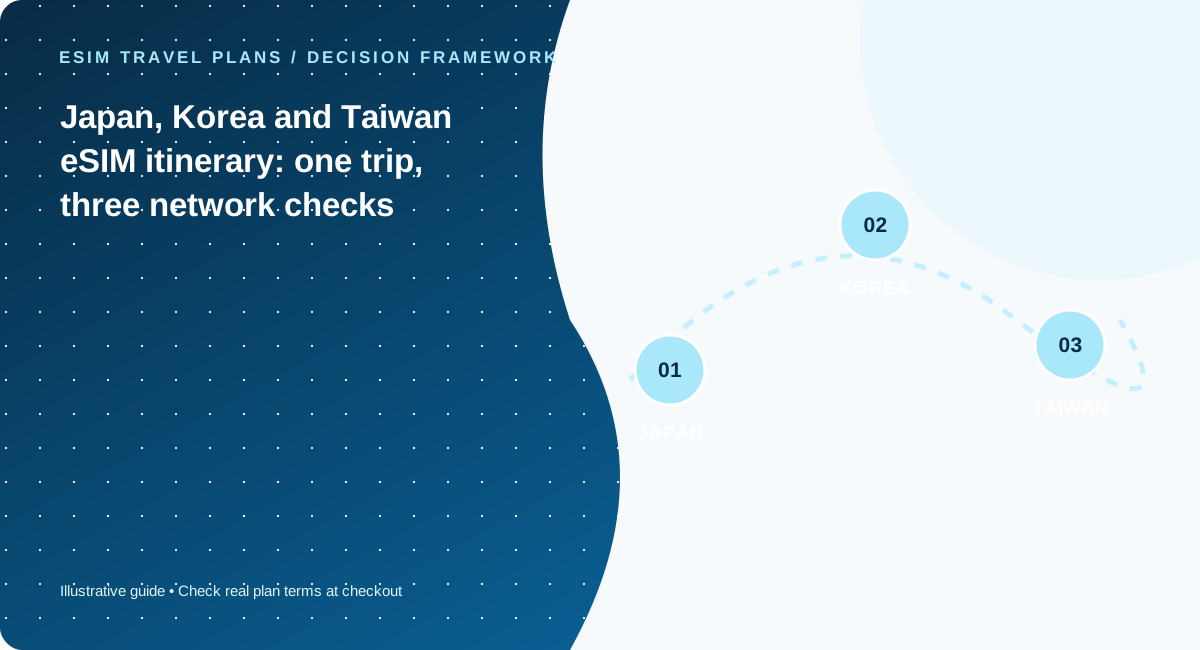
Suppose you land in Tokyo, spend four nights in Seoul and finish with six days in Taipei. Your itinerary has three separate arrival moments. Write down the local network requirement for each place and the exact date when you need mobile data. Check the plan’s country list rather than assuming that “Asia” covers all three destinations. A regional plan may be convenient, but its value depends on coverage in every stop and the total validity period.
Choose one plan or several with a failure-cost lens
One regional eSIM can reduce installation and switching effort. Separate local plans can be reasonable if one destination has a much longer stay, a regional plan omits a country, or the required hotspot allowance is different. The comparison is not simply three sticker prices versus one price. Include setup time, interruption risk, total eligible data and whether unused allowance rolls across borders. Check whether the plan starts at purchase, installation or first network connection.
Plan the critical first hour
Download the installation instructions and QR code before leaving your reliable Wi-Fi connection. Record how to select the travel eSIM for mobile data and how to disable unwanted data roaming on your home line. Test the operating-system flow on your device without assuming activation must happen immediately. On arrival, verify the travel line is enabled and data is routed to it, then check basic messaging and maps before leaving the airport.
Prepare an offline fallback
Save your hotel address, offline navigation, tickets, boarding passes and booking confirmations. One eSIM does not replace preparedness for a tunnel, rural detour or unexpected border crossing. If you rely on a local number for OTPs or voice calls, keep the home line active only after checking the home carrier’s roaming and voice charges. Data-only eSIMs do not automatically grant local calling or SMS.
Worked route example: a 15-day itinerary
Imagine five days in Japan, four in South Korea and six in Taiwan. Start with the travel calendar, not the mobile plan. Put the three arrival dates and departure dates in a table, noting any overnight flights or time zone changes. Next, compare a regional plan whose exact official country list contains all three countries against the basket of individual country plans. Write down whether the data pool is one shared allowance for the entire 15 days or whether each separate purchase carries its own expiry. A cheaper regional package is only appropriate if all three countries are included at the needed service level, the plan is compatible with your device and the validity reaches the final landing day. Treat advertised 5G access as a conditional radio/network capability, not a guarantee of a particular throughput. The most valuable outcome is a simple note you can consult immediately on landing: which eSIM to turn on, which line carries data, and how to contact the seller if it does not connect.
Evidence to request from a retailer
For each eligible plan, look for a definitive coverage-country list rather than only a regional map, and check whether the same SKU handles all stops without switching profiles. Compare first-use rules carefully: a plan valid for 15 days is not automatically suitable if a compulsory activation happens two days before your journey begins. Ask which local networks are available in each country, but do not confuse a named network with guaranteed 5G at every destination. If hotspot matters for work, find the plan-level permission or limit. Finally, inspect whether voice, SMS and local numbers are provided—most data-only travel products should not be treated as phone-number replacements. A country-specific local plan can be the better option if one stop is long or the regional service excludes a critical destination. The decision can be revisited for each border without discarding your entire plan.
Five checks before you pay
- Write Japan, South Korea and Taiwan separately into the coverage check
- Compare validity with the total trip including arrival days
- Confirm device is unlocked and eSIM-capable
- Keep the QR code and support instructions available offline
- Verify hotspot and voice/SMS assumptions before purchasing
Common mistakes to avoid
- “Asia” in a plan title does not establish Taiwan or Korea coverage
- Installing an eSIM does not necessarily mean its validity clock has started
- A data-only plan does not provide a new phone number
Work with your real itinerary or quotes
Use our free in-browser calculator, then verify live plan stock, exact destination coverage and final charges directly with TripoSIM.
Commercial disclosure: we are owned by BroadNet and promote TripoSIM. No specific retail SKU or guaranteed price is represented here.
Source notes and review standard
This page is educational editorial analysis dated 5 November 2026. It does not claim field measurements, current retailer inventory, exclusive third-party quotes or verified network speeds. Confirm the exact product terms and local phone configuration before paying.
Additional context: our research methodology and editorial standards.
Continue reading
Travel eSIM with your normal number: a two-line arrival guide
Use a travel data line without accidentally moving calls, SMS verification or roaming data onto the wrong SIM.
Family of four traveling abroad: the eSIM setup checklist
A family plan is a coordination problem: four devices, different ages, and multiple failure points.